About this book
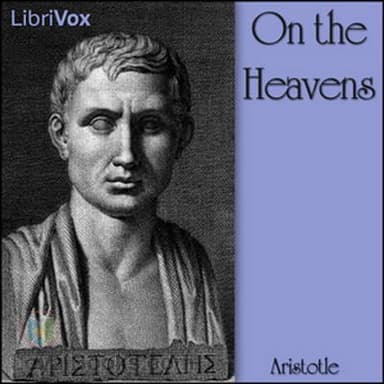
Aristotle's foundational cosmological treatise, *On the Heavens*, presents the ancient philosopher's revolutionary understanding of the universe and the physical laws governing celestial bodies and earthly matter. In this seminal work of classical philosophy and early science, Aristotle constructs a comprehensive model of the cosmos, arguing that Earth itself is spherical—a claim he supports through observable evidence such as lunar eclipses. He then develops his groundbreaking theory of natural motion, proposing that objects containing "earth" are inherently drawn toward the center of the universe, with their speed of descent proportional to their earthly composition. Conversely, matter he identifies as "fire" naturally rises away from this cosmic center, establishing what later thinkers would recognize as an early framework for understanding gravity.
Beyond his own theories, Aristotle critically examines competing ancient perspectives, including Pythagorean mathematics—which posited numbers as the literal building blocks of reality—and Democritus's atomic theory of matter. This exploration of how matter behaves and moves through space makes *On the Heavens* essential listening for anyone interested in the history of science, ancient philosophy, or the intellectual foundations of Western thought. Whether you're a student of classical texts, a philosophy enthusiast, or simply curious about how the ancients explained our physical world, this audiobook offers profound insights into humanity's earliest systematic attempts to comprehend the cosmos.